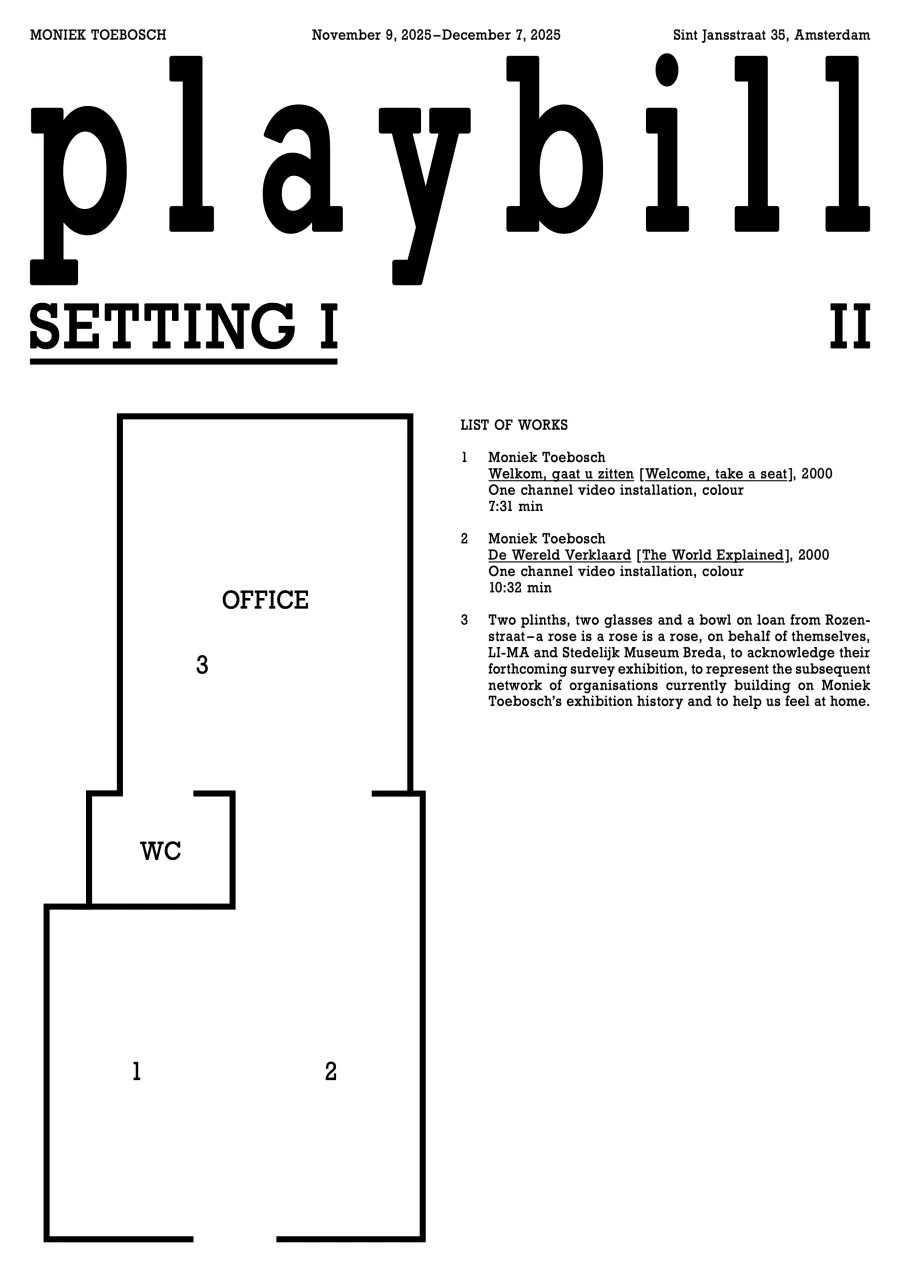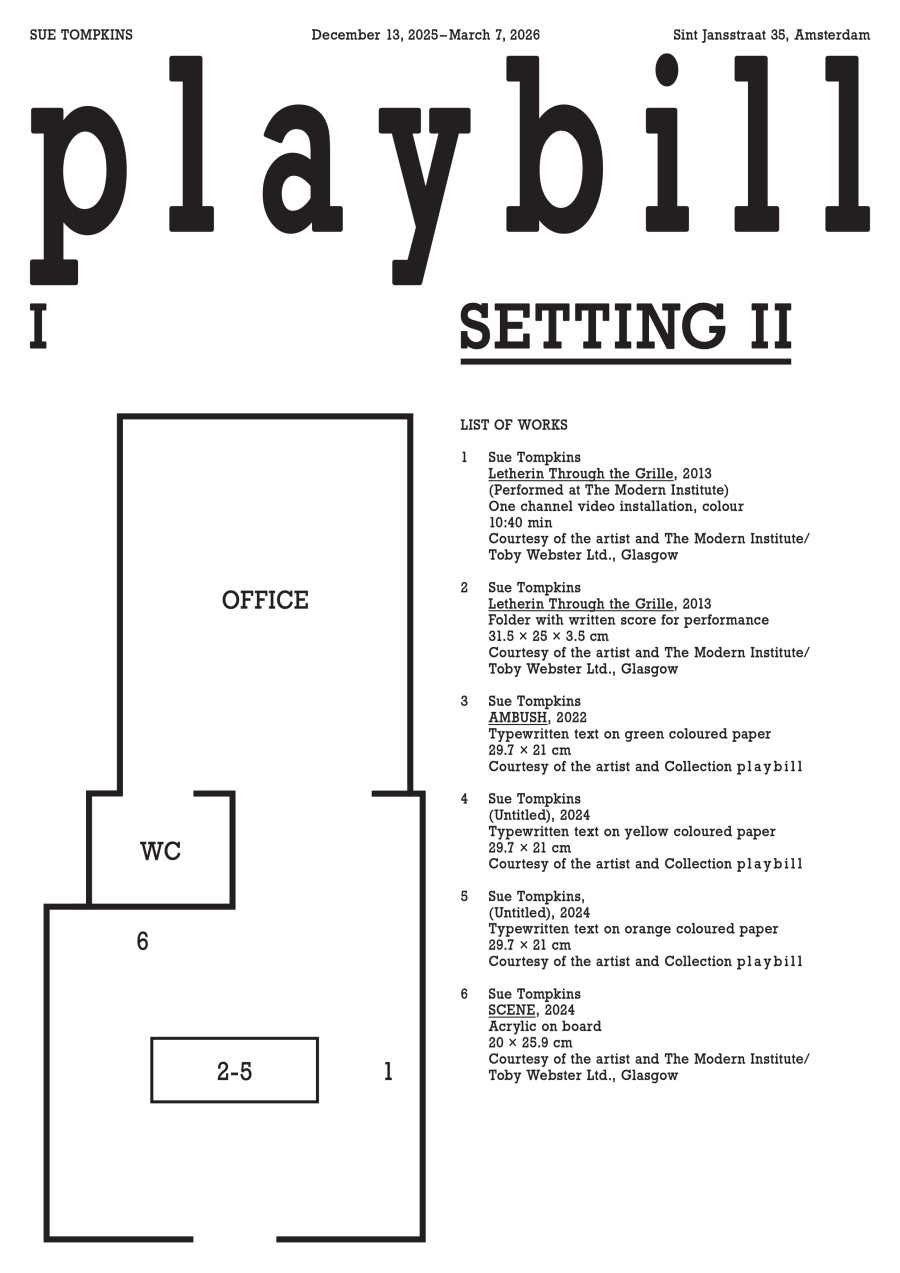
Setting III
October 2, 2026 – January 31, 2027
Sint Jansstraat 35, Amsterdam
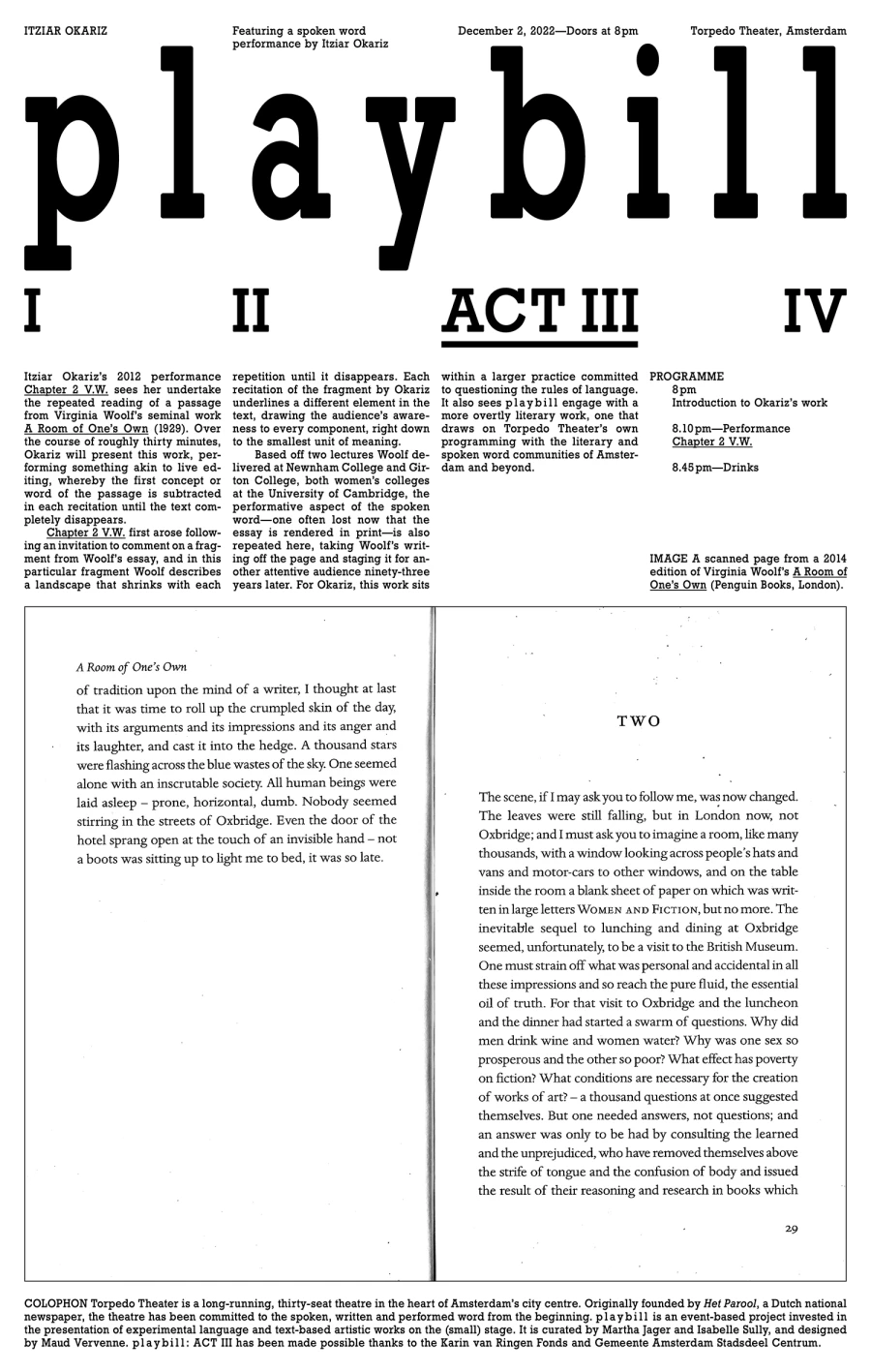
playbill is very excited to welcome you to SETTING III: Itziar Okariz, the third edition since opening our space at Sint Jansstraat 35. Where SETTING I and II, with presentations by Moniek Toebosch and Sue Tompkins, were focused on settling into our new space and investigated exhibitions as a form of translation, with SETTING III we shift our focus from inside to outside, and to body language as a way of taking and marking space.
The location of the exhibition makes this shift particularly immediate. playbill is situated on Sint Jansstraat, a street where urination in public is a recurring form of marking the city, particularly in its corners. One of these corners has been fitted with an object of so-called hostile architecture, designed and placed in an attempt to prevent this behaviour. Its design responds specifically to the standing posture conventionally associated with men urinating against a wall, turning the architecture itself into an instrument for regulating how a body may occupy and use public space. Seen from the perspective of Okariz’s work, the object becomes an unexpected counterpart: where the street attempts to stop and contain a gendered bodily gesture, Okariz deliberately adopts and repeats it, relocating it into different public and private settings. The corner of Sint Jansstraat and the exhibition therefore meet around the same questions: Who is allowed to mark space with their body? What kinds of bodily behaviours are permitted in public? And how does architecture participate in enforcing these distinctions?
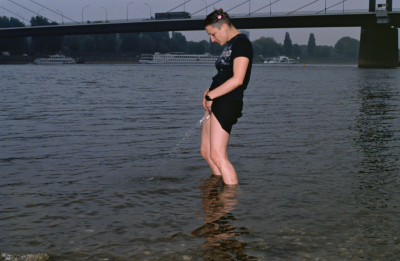
At the centre of the presentation is a selection of nine videos from Okariz’s series To Pee in Public and Private Spaces (2000–2004), which playbill has the honour to show extensively in public for the very first time. Across the series, Okariz appears in different locations, lifts her skirt and urinates standing up. The gesture is simple and deliberately repeated, but its meaning changes with each site: a hotel corridor, a residential street, the Brooklyn Bridge or another space positioned somewhere between public and private. Rather than treating the body as something neutral within these surroundings, Okariz makes visible the rules through which bodies are expected to occupy them.
This attention to the ways bodies and architecture mark one another also connects to Okariz’s interest in the architectural image and its histories. The work can be read alongside the figures of gargoyles that inhabit the façades of buildings: bodies attached to architecture, projecting outward from it, and often associated with acts of discharge, protection and surveillance.
Repetition is central to the series. The same action returns from one video to the next, while shifting surroundings continually alter the terms through which it is read. Installed at playbill, the nine videos are distributed across a constellation of four screens, with a different composition shown every four weeks. The installation extends the logic of the work: no single image or location fixes the gesture’s meaning. Instead the videos accumulate and reappear, allowing the relationship between body and site to remain in motion.
In the back of the space, usually used as playbill ’s office, a slide projection brings together still images from the series Peeing in Public or Private Spaces made in Düsseldorf in 2000. Moving from video into photography, the repeated gesture is held momentarily in place while repetition is emphasised by the sound of the moving slides. The photographs return attention to the particularity of each scene—to the architecture, surfaces and boundaries against which Okariz’s body appears—as the mechanical rhythm of the projection insists on the serial nature of the work. The act remains the same while simultaneously reinventing itself anew each time through its response to the conditions in which it takes place. It is within these shifts that the work asks how a bodily gesture is shaped, read and transformed by the spaces through which we move.